
Point source vs line array
Both are right, in different rooms. Depth, ceiling height and how the seats are arranged decide which one you want — not the size of the budget.
What actually differs
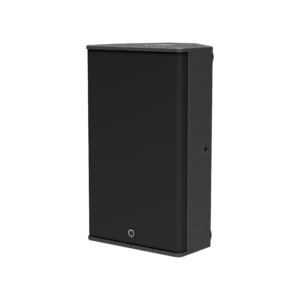
A point source radiates from one origin with a pattern fixed by its horn. A line array is many modules coupling into one tall source, with vertical coverage set by hang length and splay. One is aimed; the other is shaped.
Level over distance
A single box loses roughly 6 dB per doubling of distance. A long, correctly curved array behaves closer to a line source across its near field, which is why the back row still gets a mix and the front row is not punished for standing there.
Cost, rigging and time
An array needs steel, motors, load calculations and modelling. A point source needs a pole and an aim. In rooms up to roughly 20 metres deep the point source is usually cheaper, faster and just as good — so that is what we will quote.
Side by side
| Point source | Line array | |
|---|---|---|
| Typical depth | Up to ~20 m | 20 m and beyond |
| Vertical coverage | Fixed by the horn | Set by hang length and splay |
| Level over distance | ~6 dB per doubling | Slower falloff across the near field |
| Rigging | Pole, bracket or stack | Steel, motors, load calculation |
| Set-up time | Minutes | Modelled in advance, rigged on site |
| Low frequency | Separate subwoofer | Matched flown or stacked subs |
| From Quint | T · U · R · C series | L · V series · C36 |
| Where it wins | Clubs, churches, theatres, fills | Festivals, arenas, deep halls |



Common questions
Is a line array always better than a point source?
No. An array earns its cost in depth and in rooms where vertical coverage has to be controlled. In a shallow or wide room a point source covers better, costs less and goes up in minutes.
At what venue size should I switch to a line array?
Roughly 20 metres of throw is the usual crossover point, but trim height, ceiling and balconies move it in both directions. Send us the room; the answer is a model, not a rule of thumb.
Can I mix point source and line array in one system?
Yes, and most real systems do: array mains with point-source front fills and delays. Because the whole catalog sits on one linear target curve, the fills sound like the mains instead of announcing themselves.
Do both use the same amplifiers and processing?
Yes. A-series amplifiers and a P-series processor with a factory preset per cabinet, whichever format you use. That is what lets you mix them in one rig.
Which is better for speech?
In a reverberant room, the one with more vertical control — usually an array or a column. In a dry room, a well-aimed point source is entirely sufficient and much simpler.
Plan your system with us
Send a floor plan or a rider and our engineers come back with a modelled design: cabinets, amplifiers, presets and coverage.