
Point source speakers
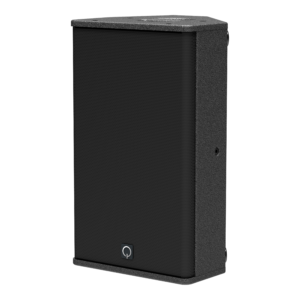
One cabinet, one acoustic origin, one pattern you can aim. Twenty-two Quint point source loudspeakers from a 4-inch install top to a 2×12-inch touring box, all voiced to the same linear target curve.
One origin, nothing to fight
A point source radiates from a single acoustic centre, so it has nothing to comb-filter against. What you measure at three metres is what the audience hears, scaled — which is why point source systems are so quick to tune.
Aim it and leave it
Fixed horn dispersion turns coverage into a geometry problem instead of a tuning problem. Pick the pattern, aim the box at the last row, and level falls off predictably from there.
A point source array, done honestly
Two or three cabinets can be arrayed for wider horizontal coverage, splayed at the horn angle so the patterns meet without overlapping. Past that, a line array is the right answer — not more tops.



Common questions
What is a point source speaker?
A loudspeaker whose drivers share one acoustic origin and one fixed dispersion pattern, so it behaves like a single source at any distance. Also called a point source loudspeaker; in Quint terms that is the T, U, R and C series.
Point source or line source?
A point source radiates spherically from one origin and loses roughly 6 dB per doubling of distance. A line source — a line array, or a column — behaves more like a cylinder over its near field, so level holds up further. Depth decides which you want.
Can point source speakers be arrayed?
Horizontally, yes: two or three cabinets splayed at the horn angle widen coverage cleanly. Stacking many point sources vertically is where it goes wrong, because the patterns interfere instead of coupling.
What is a "point source line array"?
Usually a marketing phrase for a small array of point-source cabinets. It is worth being precise: if the modules are not designed to couple, you get interference rather than array behaviour.
Which point source for a 300-capacity room?
A T15 or U15 per side over a B15 or B18 covers most 300-capacity rooms with headroom to spare. Send us the plan and we will confirm it rather than guess.
Plan your system with us
Send a floor plan or a rider and our engineers come back with a modelled design: cabinets, amplifiers, presets and coverage.